Opus

State ascoltando L’alba di un mattino che verrà N°2 (4’14”)
OPUS
1976—2026
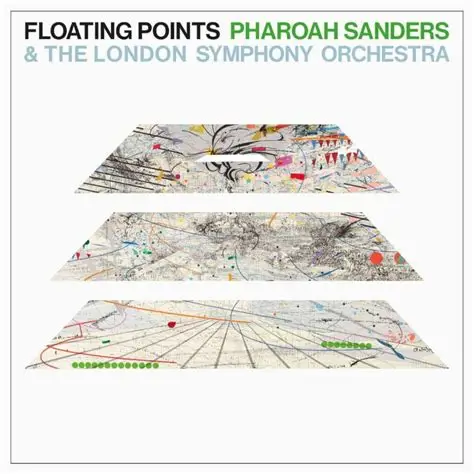
If I am to be entirely honest, I must acknowledge that without Francesco Messina this album would never have come into being. His bond with Franco Battiato was singular, as intense as it was affectionate. His suite for piano and synthesizer has proven so prescient that Floating Points and Pharoah Sanders, together with the London Symphony Orchestra, would go on to realize an expansive orchestral reimagining of that very idea.
The title, moreover, belongs unmistakably to a Gurdjieffian outlook: it is not one I would ever have chosen.
My own contribution—what I would call THE POWER OF SIDE B—lay in casting a veil of mystery and a patina of erudition, without which, I am convinced, the record would have passed unnoticed. Imagine it had been released under the outlandish name of some Italian prog band of the period; imagine, too, that I had delivered a Side B not acoustic but driven by pulsing, rhythmic synthesizers. It is easy to see that international critics would not have fallen for it with quite the same ardor.
Herein lies the album’s exquisite equilibrium: in the meeting of two worlds that voice different spiritual longings and render them in equally different forms.
There is, besides, a more prosaic problem: the internet sorts names alphabetically. In 1979 there was no internet, and the matter concerned only where the LPs stood on the shelves—likewise in alphabetical order. Today things are different: the album ends up looking more mine than his, and that is simply not fair, for it is truly fifty-fifty.
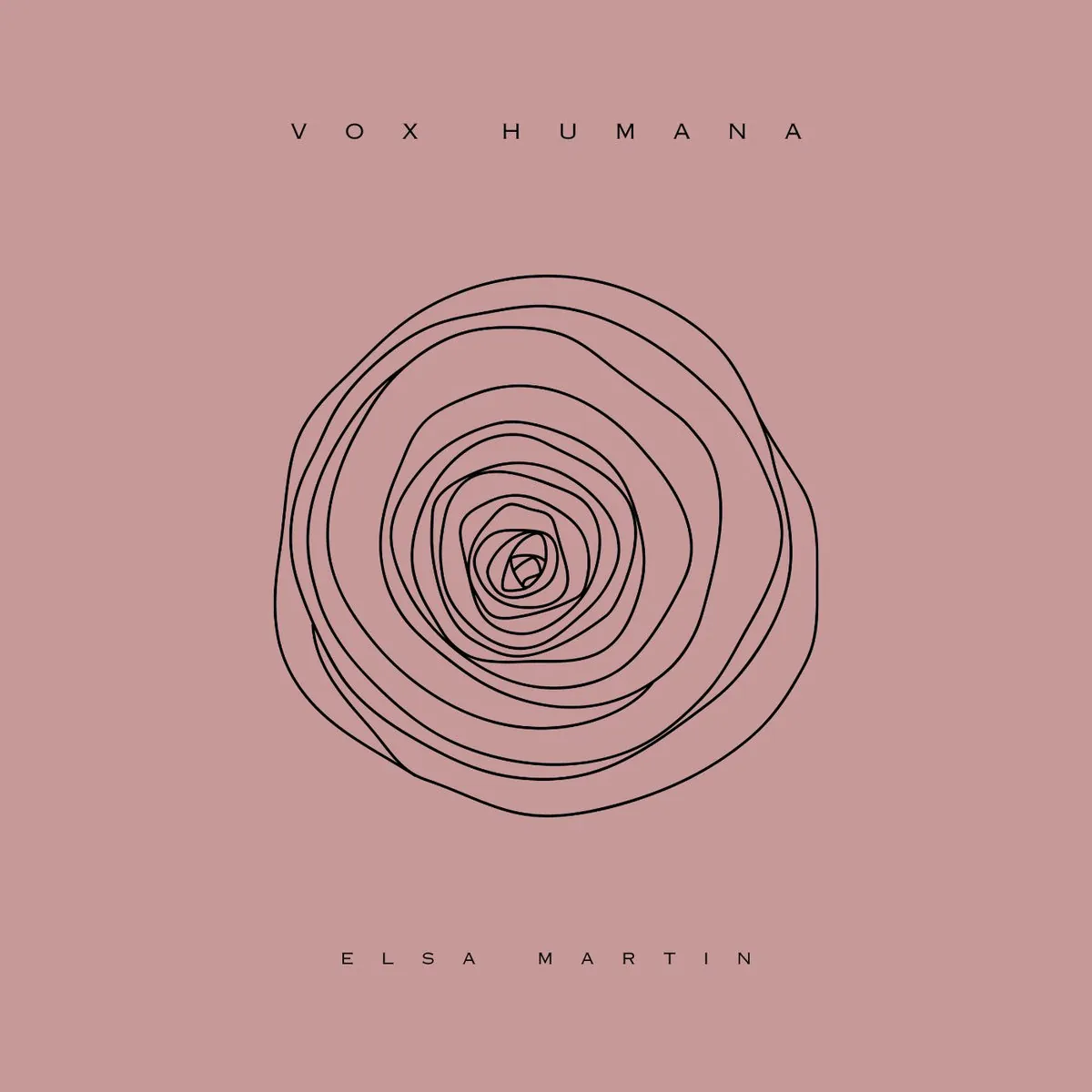
Then again, part of what makes this first work of ours so remarkable is how far ahead of its time it was: Prati bagnati del Monte Analogo dates from 1979, whereas Promises by Floating Points, Pharoah Sanders and the London Symphony Orchestra appeared in 2021. The same holds for Amon Ra, whose atmospheres resurface in Ceresârs by the extraordinary Friulian singer Elsa Martin—a piece composed by Stefano Battaglia to a poem by Novella Cantarutti and released in 2026 on the album Vox Humana. Half a century on, Francesco and I are both still trying to look ahead.
Every act of musical analysis is something of an autopsy: one dissects the corpse of music, not music itself. Music, as a living and creative experience, can be neither quantified nor grasped through critical notions or musicological learning. A physician may offer his opinion on the effects of a disease, but he cannot heal anyone with words alone, or with pharmacological abstractions.
Music, like medicine, needs—if it is to live—a continuous act of love: a force wholly foreign to the dialectical process, yet for that no less real, no less effective. Anyone living in this age can sense that ordinary thought does not encompass the whole of reality; and yet this recognition frightens us. Inner experiment and inner verification are silenced by ever more sophisticated technologies, by ever more elaborate discourse. We are “masters” of the quantitative universe, yet not free of our psychological dramas, of our inner insufficiencies: abstract thought is powerless to kindle warmth and will in human beings. To acknowledge this is not to invalidate logical thought—rather, it is to follow it through to its most radical consequences.
The composers of the twentieth century, who might have been the first to bring certain conscious intuitions to creative freedom, were charged instead with the heavy task of driving the dialectic of forms to its furthest expansion: the death of contemporary music—by asphyxia, by the exhaustion of every quantitative term—only hastens the reversal of the creative breath we are now witnessing.
Today we may draw upon the creative forces more consciously; but precisely for that reason the individual soul must assume full ethical responsibility (and not merely an aesthetic or conceptual one) for every musical thought.
Suppose we had built a Gothic cathedral: the essence of that work would lie not in its structural conception, not in the calculations of its vaults and thrusts, not in the dimensions and chiaroscuro of its windows, but in the Thought and the Will of those who conceived and raised it, and in the Feeling of the faithful who lived it.
That Thought was alive and potent; those beams, those drawings, those calculations, the glass, the stone—a mere means. These sounds are a mere means: their rigorous order (Hula Om) or their utter abandon (Amon Ra) serves the feeling they may awaken in the heart, the synthesis they may inspire.
Once, the rational soul governed the structures of music (the architecture of music); today we can build sonic environments (the architecture of lived experience). There is a clear direction that may lead us to experience the Architecture of the Living—but that possibility is bound up with the degree of consciousness humanity has attained.
The hyper-dialectical disciplines of musical semiology have come to conceive of the experience of “lived music,” yet the absence of a Synthetic vision forecloses any creative development: once again, the analytical gaze comes to rest on corpses, on precipitates.
At this point I ought to tell you about the two compositions on this record; yet I consider it essential that listening—in the absolute sense of the word—precede the few descriptive images I shall offer.
Hula Om is built upon an initial series of 25 notes, divided into five rhythmic-melodic cells; their continual permutation leads us to the verticality of the final chord, which presents itself as a synthesis of the whole path travelled. As the piece moves past its midpoint, time gradually dilates: the synthesis begins to transcend the initial model only once every combinatorial possibility under consideration has been exhausted.
The harp’s tuning has been subtly altered; the entire piece is cloaked in a geometric nonchalance.
Amon Ra asks for a different disposition: the environment it creates is an act of devotion to the sonorities that surround our sleep. Schumann perhaps experienced this world directly, but was destroyed by madness, for he could give himself no conscious account of it. The ethereal resonances of this piece are produced not by electronic instruments but by a glasspiel—crystal glasses made to sing beneath moistened fingertips. The voice is that of Juri Camisasca; to him I dedicate this piece, into which he poured his whole self with fragrant devotion.
Francesco Messina
Scales and Steps
The ascent has to begin somewhere.
Mountain lovers know that not even the meadows of the gentlest slopes can be reached without effort; those who have read Daumal will understand.
(Hoping is no crime.)
In any case, should the excursion wish to continue from here, it will have to do so with gradual awareness.
Hence the well-known saying: “No one knows when the first drop fell, but it is certainly raining now.”
Sometimes, right from the start, unforeseeable oddities occur: one spends sleepless nights rummaging through archives once out of bounds, evicting ideas crammed into hundredth-hand sublets—hospitable and seductive, until now, only to idleness. (Must be the air?)
Alas, the party almost always ignores itself, and private enterprise invariably opts for the most nauseating detours—confirming that tourists, whether those of Venice or those who roam about inside ourselves, always end up getting lost.
Desertions multiply once it is discovered that the summits (stormy, perhaps?) lie hidden behind a disheartening false ceiling of cloud; but the world, say I (lower-case i), the world, as I was saying, already has its fill of the “safe and sound,” and of the “hale and hearty” too—yet of the truly “alive” there are precious few, and though they are hardly in demand, the matter holds our interest. So: bag and baggage, straight on ahead. Well said!
Naturally, “straight” is only a manner of speaking, since words may well remain mere words, however neatly strung like beads—on account of a few kilograms of flesh and marrow, upon which the skull timidly rests, busily dreaming of restful beaches and deaf to every summons. (Even in Esperanto.)
This inevitably calls to mind the more wholesome reality that counsels us to content ourselves (for now?) with more accessible crossings through the woods.
Unfortunately, one is not easy to find, since it is usually hidden behind the first tree.
Moreover, the lower altitudes are the paradise of the absent-minded, who—hypnotized by the din of their own footsteps—manage, with involuntary precision, to bore themselves while sidestepping even the most resounding scent, rustle, wingbeat or glint, call it what you will.
In any case, for those exempted for life from looking more closely, what matters—as it always has—is taking part.
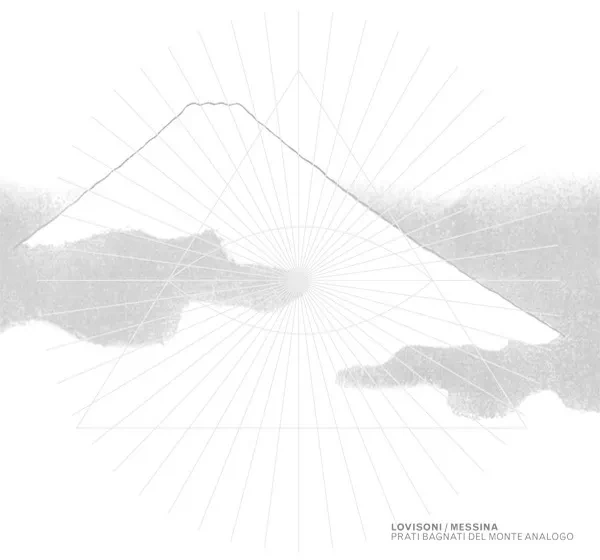
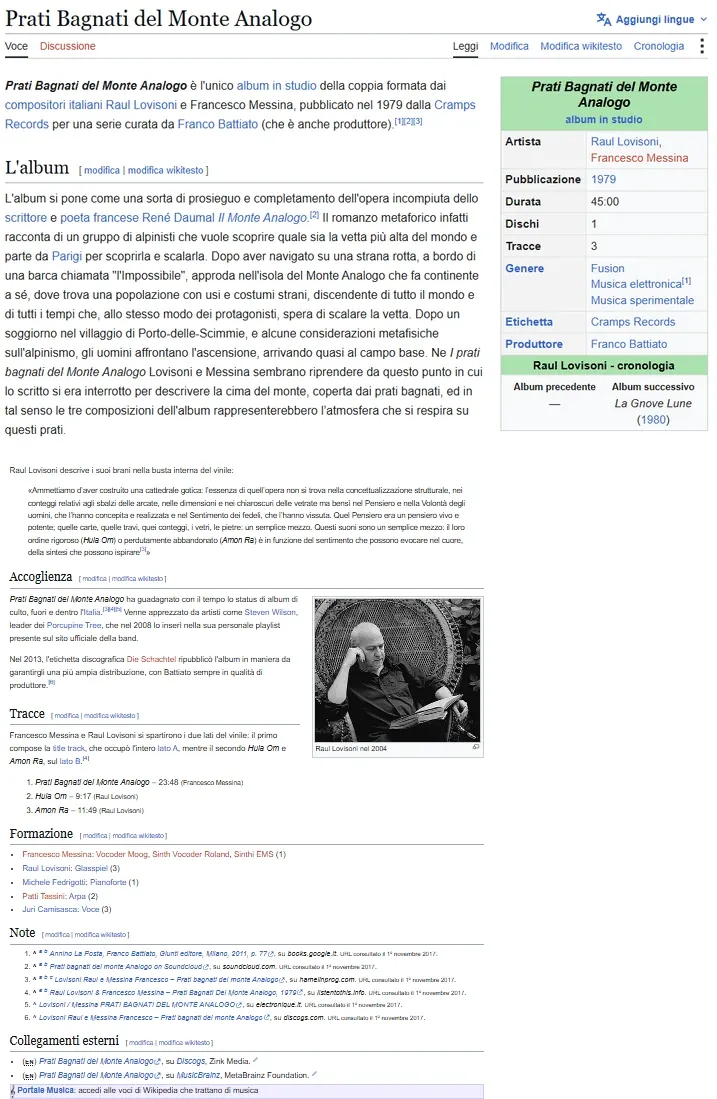
In 1979, with the help of Francesco Messina and Franco Battiato, the LP Prati bagnati del monte Analogo went to press. It was a work of the most extreme avant-garde—or, as the critic Achille Bonito Oliva was then calling it, of the Transavanguardia. At the time, Lovisoni’s first record found no understanding beyond a small circle of minimalism’s devotees. In time it became a cult album, in Italy and abroad. Strange as it may seem, the record’s masterstroke was the very disparity between its two sides. Francesco and Raul decided to give one side to each, filling it with their own compositions and their own, quite different, sensibilities. Francesco’s suite was electroacoustic; Raul’s, rigorously acoustic. On Messina’s side the piano rose above deft carpets of synthesizers; his atmospheres were softly dreamlike and exquisitely delicate. Side B, Lovisoni’s, held two pieces. The first, Hula Om—the hula hoop of the gods—is a piece for harp in Pythagorean tuning, unfolding according to an almost mathematical model. Almost hypnotic, it travels from its opening melody to a vertical sequence of chords at the close of its nine and a half minutes. The second, Amon Ra, was played by Raul on the glasspiel: glasses tuned with water and sounded by friction. Amon Ra featured the voice of Juri Camisasca, in a style inspired by Indian classical music. Its title invokes an ancient solar deity—the One God, the Sun, king of all the gods of the Egyptian pantheon.
Whatever the differences between its two authors, something binds the whole together. But what was it—what is it still—that so captivates in Prati bagnati del monte Analogo? Today, some forty years on and after repeated reissues (legitimate and bootleg alike, even in Japan), we may attempt an answer. As a piece of communication, the record was a gamble: the commercial logic of the day called for a true collaboration, a unified sound. And yet had Francesco and Raul formed a group on the model of Popol Vuh, whom both adored, the vinyl would have seemed far less interesting. It was precisely the stark contrast in timbre between the two sides that made it unique. Why? Because the work obliges its listener to make no small effort of aesthetic understanding. Whoever puts it on the turntable, and then turns it over to hear Side B, may find himself wondering, half-consciously: “What do these two sound-worlds mean—these two such unequal stories?”
Then there was the cover, chosen by Gianni Sassi, the shrewd Milanese record man who produced the album. In full color, it was about as absurd—rationally speaking—as anything one could conceive. Sassi was a record producer, but also an adroit inventor of cultural marketing; let us say that, to make ends meet, he also ran advertising campaigns. Sassi, with characteristic wit, chose to dress a record of minimalist music, with a sacral vein running through it, in an outrageous sleeve. One finds oneself holding a painting complete with palm trees and the little tables of a café at night—images that suggest the tête-à-tête of a dandy and his belle. The two figures seated at the café are dressed in white: she in a long gown, he in a tuxedo. The mood is hushed, yet worthy of a scene from The Great Gatsby. We are somewhere in the nineteen-thirties or forties; behind them, a bay dotted with palms and romantic lights. The semantic incongruity is plain to see, and yet, from a promotional standpoint, Sassi had not put a comma out of place. The reason is soon revealed. First: the title was unintelligible to most, since the public at large does not know René Daumal’s novel Mount Analogue. Daumal, it should be said, was influenced by the teachings of George Ivanovich Gurdjieff, and the title was chosen by Francesco, who holds this Greek-Armenian thinker in the highest esteem. Anyone with a modicum of curiosity who tried to fathom the title would find himself caught on the hook of esoteric fascination. Remember, too, that there was no internet then, so any direct knowledge of an author depended on bibliographic research. Second: the two sides are so unlike in timbre that the object itself piques one’s musical curiosity. Third: what on earth does the inner ascesis to which Lovisoni’s and Messina’s pieces allude have to do with that cover? Fourth: the album’s liner texts are anything but banal; they demand attention, and they speak of a spiritual quest. These four pillars, joined to Franco Battiato’s cultural prestige, made for a potent brew—for anyone blessed with intellectual curiosity.
Beyond the beauty, or otherwise, of the music, engaging with this work has become a mark of distinction: to own it is to signal a refined taste. Over the years Raul has witnessed the follies of collectors prepared to pay astronomical sums to hold an original 1979 copy in their hands—collectors who, for that matter, are wholly indifferent to the music itself, something a composer cannot begin to understand. Still, the album left its mark on the musical taste of the decades that followed. Prati bagnati del monte Analogo has found its most ardent admirers abroad, among them Steven Wilson, the leader of Porcupine Tree, who in 2008 included it in his personal list of memorable recordings.
After this long preamble, we come to the unfortunate episode between Lovisoni and Sassi—two men who never once spoke in person, nor even on the telephone. The moment Lovisoni saw the proof of the cover, he was scandalized and dismayed. He telephoned the designers and tried to explain that for him this was an album of sacred music, and that the nocturnal party Sassi had proposed was, how shall we say… sacrilegious. The staff at Cramps Records reported the conversation to their boss. Sassi flew into a rage and threatened to halt the pressing. It was Franco Battiato who stepped in and, with his intelligence and his gift for mediation, set everything right. Battiato, after all, was Messina’s closest friend and had mixed Lovisoni’s Amon Ra, and Gianni Sassi thought better of burying an album proposed and mixed by the great Italian artist. Four decades later, Raul must concede that Gianni Sassi’s commercial cunning and refined judgment did much to bring the work to a wider public. Such are the mysteries of a work: once its authors have released it, it walks on its own legs toward listeners and readers unknown.
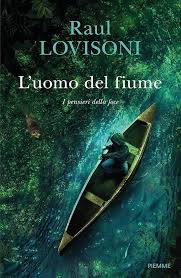
Piemme · Mondadori Libri S.p.A., MilanPrati bagnati del monte Analogo · Die Schachtel
Wikipedia, the free encyclopedia
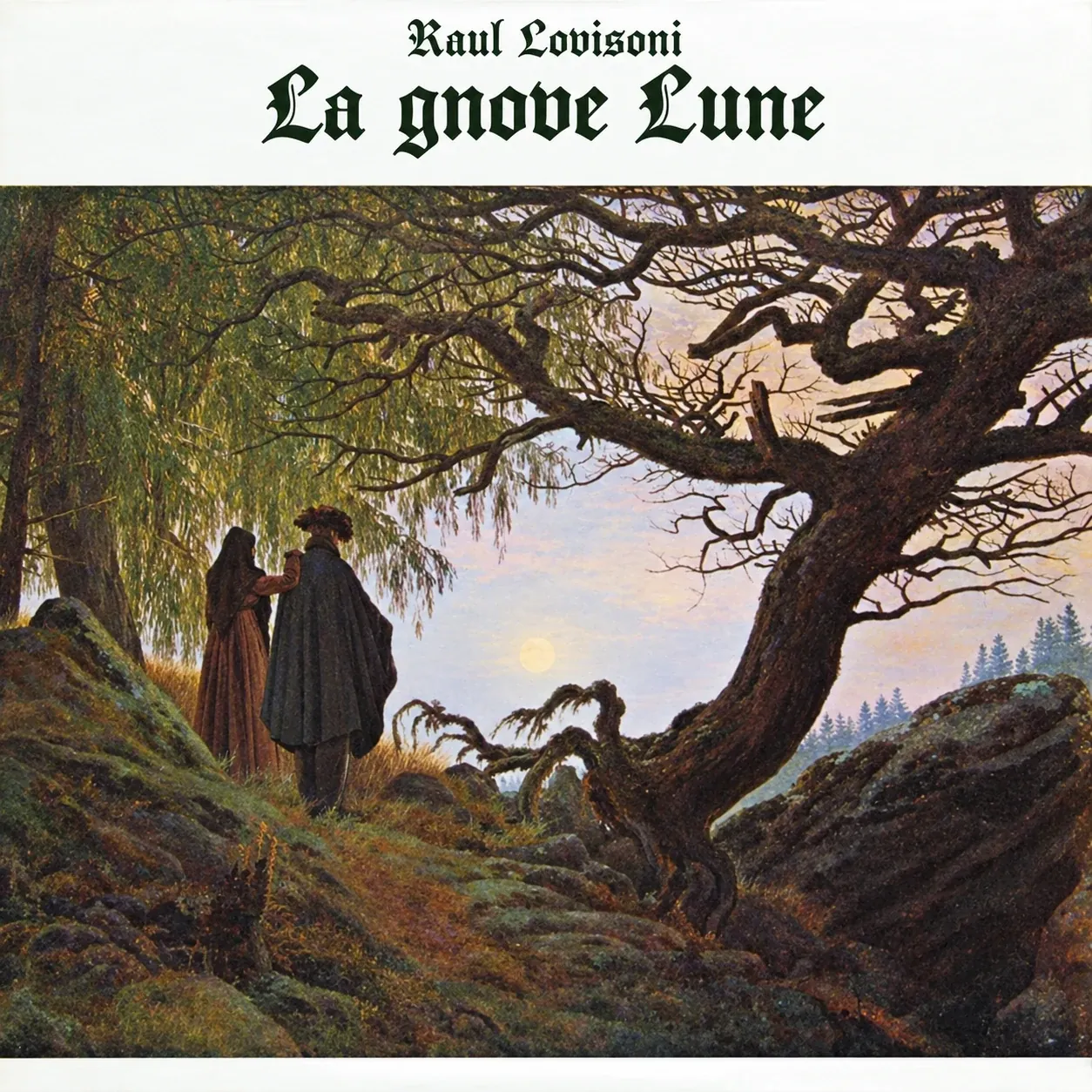
Some records, decades on, seem to ask less to be listened to than to be reconstructed. Raul Lovisoni’s La gnôve lune is surely one of them. Its scarcity, the paucity of documentation, the unusual story of its recording, and its all but unclassifiable place in Italian music have long made it the preserve of a handful of devotees and researchers. Yet its importance does not lie in its rarity alone.
Once the scant surviving discographic facts are joined by photographs of the original inner sleeve, the Friulian lyrics, the liner notes and, above all, Lovisoni’s own testimony, the album emerges as a work far more complex than its marginal place in the catalog might suggest. Into it flow the experimental ferment of Cramps, contemporary music, jazz, an acute ear for timbre, Friulian poetry, a distinct spiritual vision traceable to the thought of Rudolf Steiner—and, with surprising intimacy, the personal story of Lovisoni and his wife, Paola. To understand it, then, we must go back to Cramps Records.
The true antecedent of La gnôve lune is not Friulian music but that extraordinary moment in Italian music, in the early nineteen-seventies, when Gianni Sassi’s Cramps label became one of the few places where experimentation could find its way onto vinyl.
Within that laboratory, the figure of Franco Battiato is central. His first Cramps period—Fetus, Pollution, Sulle corde di Aries—stands among the most radical attempts to free Italian composition from the conventional song form and to turn music into a perceptual, timbral, and conceptual experience. Among the high-water marks of Battiato’s work for Cramps as producer and talent scout is, beyond doubt, Prati bagnati del Monte Analogo, made by Raul Lovisoni with Francesco Messina. The title recalls René Daumal’s unfinished novel Le Mont Analogue, and already harbors the idea of a journey toward a place that belongs at once to reality and to symbol. The long composition that fills one side of the record—with Michele Fedrigotti at the piano and Messina’s electronics—sits squarely within the climate of minimalist experiment Battiato had explored shortly before, notably on L’Egitto prima delle sabbie.
But it is in Lovisoni’s half that something emerges that proves essential to understanding La gnôve lune. Two elements appear here that will return: the harp of Patrizia Tassini, and Lovisoni’s glasspiel, made by setting crystal glasses ringing. This is no mere coincidence of instrumentation. The same harpist, the return of the glasspiel—these point to a concrete continuity between the two works, and to a method: Lovisoni seeks sonic possibility in what is not ordinarily considered an instrument at all. The glass becomes music. A few years later it will be the Friulian language that becomes musical matter. The continuity between Prati bagnati and La gnôve lune is not simply one of style. From Cramps, Lovisoni carries forward certain fundamental ideas: the primacy of timbre, the dilation of time, the unconventional use of instruments, the pursuit of a spiritual dimension through sound. What changes is the direction of the journey.
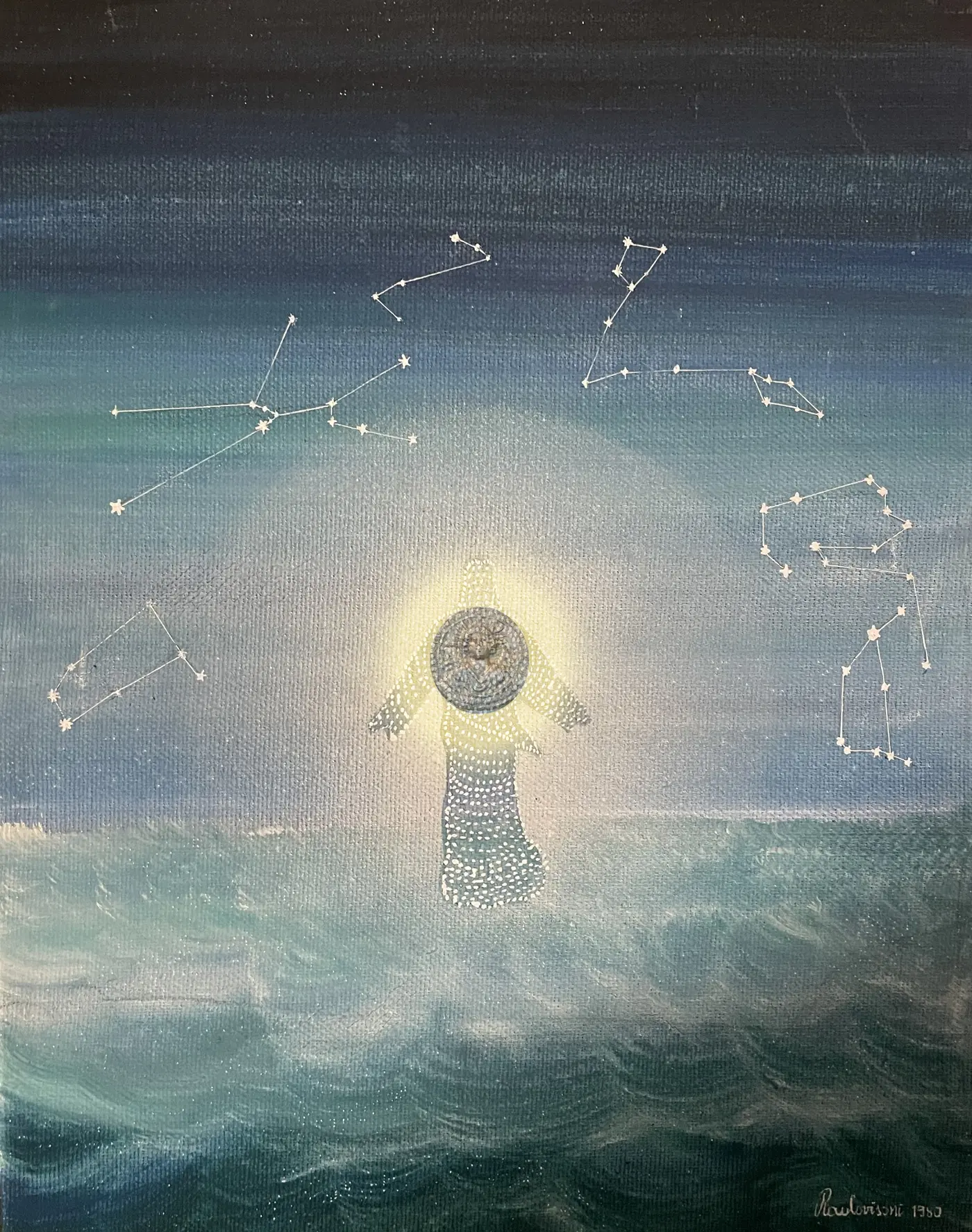
In Mount Analogue there is the mountain, the ascent, the journey toward an impossible place beyond the world. In La gnôve lune we find instead the night, the nadir, the stars, Atlantis, the sunken world. It is as though the vertical quest of Prati bagnati had discovered the necessity of descent as well: into matter, into memory, into language, into one’s own land. The first record seeks a place outside the world; the second seeks that place within the world—within a language, a culture, a memory.
Though born in Cremona, Lovisoni is Friulian through and through by cultural belonging. The language he writes in, the milieu that formed him, the network of musicians he works with, and above all the very conception of La gnôve lune bear this out. Friulian is not a language applied from outside; it is one of the work’s constitutive elements. Lovisoni brings contemporary idioms into the Friulian tongue and lets the language transform them—metabolizing modernity from within.
The album’s very gestation helps frame the nature of so complex a work. The documentation places the recording anywhere between 1980 and 1982. Asked directly, Lovisoni—without committing to a precise date—confirmed that the process stretched out at great length, until the studio’s owner issued an ultimatum. The record was made at Checo Comelli’s AVF studios, a world away from the production machinery of a major label.
Lovisoni recalls that, among those taking part, practically only he and Armando Battiston already had recording experience. The written parts were chiefly for harp, winds, and classical guitar; the rest grew from the interplay among the musicians, in a spirit of improvisation as mutual gift—a spontaneous collective dimension that needed no authoritarian direction to find its key.
One element his testimony illuminates is precisely Battiston’s role. Lovisoni finds his jazz contribution especially interesting because it entered a musical fabric that was, at the time, fairly classical, its written parts largely innocent of sevenths and ninths. Battiston brought into the compositional weave a different conception of harmony, made of the tensions and colors proper to jazz. The music thus arises from the meeting of notation and freedom, making the work resistant to every label: it is not art music in the strict sense, nor prog, jazz, folk, or ambient—though it anticipates certain conceptions of ambient sound. Lovisoni’s account adds details that reveal an intriguing web of family ties. On drums is Ario Comelli, son of the studio’s owner, who was himself related to Paola, Lovisoni’s wife. Behind the album, then, stands no anonymous industrial machine, but a local studio, a family, personal bonds, musicians who know one another, a labor drawn out over time—a mode of production very different from Cramps’, yet one that preserves something of its experimental, ever-evolving workshop spirit.
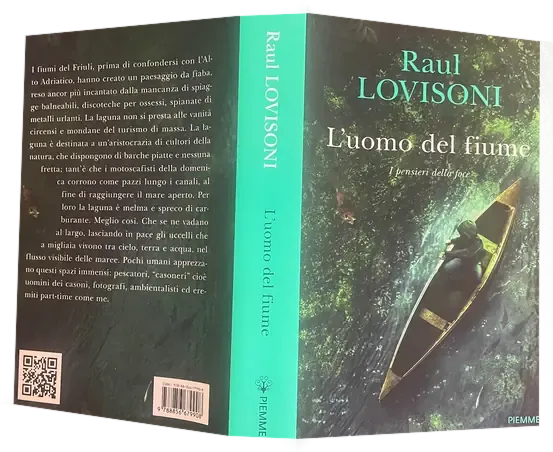
Paola, who inspired the album and to whom it is dedicated, played a decisive part in its birth, its development, and the shape it finally took. In his book L’uomo del fiume, Lovisoni relates that she was not especially fond of an approach so bound to the idioms of the avant-garde, and pushed him toward a more immediate form: the song. This explains the album’s inner tension—on one side, the experimentation and spiritual search of Cramps; on the other, Paola’s wish that the search be made communicable through song. Metaphysical striving is given voice—in lyrics, in verses, in melodies. Paola thus becomes an invisible yet structural presence: the earthly pole around which the composer’s cosmos turns. No less essential is the work on the lyrics, revised by the poet Meni Ucel, known for his Friulian translations of passages from Dante. The inner sleeve preserves a precious linguistic record: the lyrics do not follow the standardized Friulian spelling we know today, since no such codification yet existed. This original orthography is a historical document, and the phonetics, accents, and sonorities of Friulian become compositional elements in their own right.
The sequence of tracks on the inner sleeve reveals the album’s true architecture, which takes shape as a mythology of the elements:
Seen in this light, spirituality is not an escape from the world but a transformation of one’s relation to reality and to the deep forces of the soul. The new moon, the fire, the descent, and the stars thus take on a precise initiatory and existential significance: the moon stands for the lunar dimension, for the forces bound up with consciousness that the I is called to transform—bringing conscious strength into the darkness rather than fleeing it. Fire acts as an alchemical and metaphysical principle of destruction and regeneration. The nadir, the descent, become crucial. Where common spirituality conceives of ascent as the only spiritual movement, in the Steinerian view that Lovisoni has made his own, the descent into matter, into night, into the depths—to the lowest point—becomes a necessity. To reach a new form of light, one must pass through the whole of reality, the earth, and memory. This makes clear why Lovisoni’s search leads not out of Friuli but deeper into it. The anthroposophical outlook becomes incarnate in a concrete culture and language, refusing any esoteric or decorative Orientalist repertoire in favor of an elemental, cosmic mythology.
The meaning of the final track, Tu vivâras!—“You will live!”—is the one that has changed most with the passing of time. Conceived originally as an answer to the disappearance of Atlantis—the affirmation of life reborn after destruction, completing the cycle of the moon—it now takes on a profoundly different weight.
Since Paola’s death, Lovisoni has come to regard the song as almost eerily prophetic. Prophecy here is not to be understood in a supernatural sense, but as something wrought by time: a phrase transfigured by the life its author went on to live. The words “you will live” have become a private memorial. Paola was the earthly presence who pushed him toward song; today that same song keeps her memory.
The record itself goes on living and changing over time. Consider Lovisoni’s suggestion, today, that it be heard slowed to 432 Hz, to soften its sonic texture—proof that the work is no frozen artifact but a living organism, in perpetual transformation, changing with whoever listens to it.
Described by Gigi Maieron and Lino Straulino—two institutions of Friulian music—as the record of an “alien,” capable of ferrying avant-garde idioms into the new Friulian music without yielding to folklore, the album was born and circulated under the sign of the gift (witness the five hundred copies that Zamparini, its producer, set aside for his Mercatone stores, and the communal spirit of the AVF studio). In the end, La gnôve lune fulfills its own mythology: the moon disappears in order to begin again; Atlantis disappears in order to be remembered; a beloved person dies in order to live on in memory; and a record at the margins of official history resurfaces from oblivion. In this perfect circuit, Tu vivâras! is not merely the title of the last track but the definitive answer that the whole work, more than forty years on, continues to give to its own story.
Raul Lovisoni wrote the Friulian lyrics and performs voice, acoustic guitar, piano, glasspiel, flute, recorder, psaltery, tubular bells, bowed guitar, synthesizer, glockenspiel, percussion, and effects.
The musicians
Paolo Bergamo, Marco Blasig, Fabio Cascioli, Fabio Sambo, Gianpaolo Vatta, Armando Battiston, Patrizia Tassini, Flavio Zaina, Ario Comelli, Enzo Mitidieri, Ester Sallai, Antonella Fonda, Checo Comelli, Paola Pauluzzi, and the Amici di San Giorgio choir.
The Friulian language is no ornament but the living matter of the work. The lyrics are by Raul Lovisoni, revised by the poet Meni Ucel and by Professor Giovanni Frau.
Ensemble
Fifteen musicians and a choir
Voices, acoustic instruments, electronics, and effects
Slowly, slowly the dawn breaks / beyond the mountain peaks, / and the moon, so white, so white, / slips away into the far distance.
This peace, this poetry / fills the whole of your heart / with a joy, a gladness / that rises in your throat like a knot.
From behind the mountains / the sun, risen high, / kisses you on the lips / in the very instant you draw breath.
(Woman’s voice) “My heart is a nest of nightingales singing to one another, and they lift me to float upon the air.”
(Man’s voice) You fade into the fragrant air, not fully awake; you scatter yourself over the fields, never quite awake within yourself.
(Woman’s voice) “Fly, fly…”
No longer in the loveliest of dreams will you find the Divine, but in the living heart of a thought followed all the way down.
For the world today is harder, a world shaped by precision, and your heart must be set free of its illusions.
And before you pour fire into the heart, you must cross beyond the ice of the reasoning mind.
Only then will you be a ray of Light returning to its Sun, returning to freedom.
And death, with its scythe, cannot so much as graze the one who lives on with no body left to lean upon.
You will live!
Tu vivâras / You Will Live (1980) · 6:42
Forty years before my mother died, and thirty-five before I lost Paola—my wife, who now lives in the Light—I wrote a song called You Will Live! Late one September night, a dream brought it back to me. At 2:23 a.m. I switch on the bedside lamp, the song still playing in my head, and think: “How strange that this record should come back now. A song?! If I mean to say a proper goodbye, I should give them the thoughts they never wanted to hear from me.” I turn off the light and fall asleep again.
Now, as I search for a way to end this story, that forgotten piece from 1980 comes flooding back. I listen to it again, carefully, and understand that I wrote it for them as well. The endless embrace in which I reach my mother and my bride in the Beyond is steeped in this song—whose title, not by accident, is You Will Live!
The song opens with a poem by Antonio Cadel, a Friulian poet of the last century. I chose those old lines on purpose—and was duly scolded by a Friulian scholar for mixing, in a postmodern spirit, another man’s verses with my own. But that was exactly the point: to set the world of yesterday, soaked in sentiment, against the world of today, which asks that a light of awareness be turned on our emotional inertia.
Picture a forest of mystery stretching from the mountains to the sea.
Such was Friuli in the Middle Ages, in the days of the Patriarchs of Aquileia.
The leaves lay over it like a cloak of shadow — a land of spells and enchantment.
Night wore away what little sun could reach into the deep dark.
Only a child, orphaned and wild, wandered alone through the dark forest after the evening bell of Vespers.
They had named him Nadir, son of a fairy and a mortal man.
The wolf lay down at his feet; his faithful friend was a falcon.
One night he lay resting in a forsaken cloister outside the walls of Venzone.
He hears the wind howl his name from the mouth of a ruined gateway.
And all around him, ringed in a circle, a thousand hooded sorcerers, rusted sickles in hand,
murmured psalms twisted and poisoned, cackling as they sought to smother him.
And Nadir could not move, for a paralyzing nightmare had come to call.
He lay still, rigid, turned to stone, as though he had become marble.
They called him Nadir, and he was courage itself; in that moment he remembered a spell of protection.
So, in his mind’s eye, he turned his skeleton into a flashing radiance; every bone
became a blazing bolt of lightning, burning bright all the way to his skull.
And it is told that the thousand dark sorcerers, whimpering with fear, fled like hares down the ravines, their long robes, ragged and in tatters, sending them tumbling headlong.
They had named him Nadir, son of a fairy and a mortal man, and from that night on, in the cloister of Venzone,
he was given the gift of foresight.
This is the tale of Nadir.
On Discogs, 29 people list the record in their collection and 219 are looking for it. Its average rating is 4.5 out of 5. The last recorded sale dates to April 2022; documented prices range from $46 to $171, with a median of $126.
In 2016 the blog Verso la Stratosfera called it “an absolute rarity, never reissued.” In a comment from August 2026, however, a reader describes himself as “the happy owner of the CD” — an isolated account suggesting that a compact-disc version circulates online, though its origin and official status remain unclear.
Two things missing from every online source will be the true added value of this archive: the complete Friulian lyrics with their translation, and the story of the sessions in Checo Comelli’s studio. For both, the essential source remains Raul Lovisoni himself.
Discogs
29 copies listed · 219 people searching
Rating 4.5/5 · median $126
Rôs di buinore 3’20″
Music: R. Lovisoni · Lyrics: C. Puglisi, R. Lovisoni
La gnôve lune 3’20″
Music and lyrics: R. Lovisoni
Misteri dal fûc 3’32″
Music: M. Blasig, R. Lovisoni · Lyrics: R. Lovisoni (after Březina)
Nadir 6’15″
Music and lyrics: R. Lovisoni
In che gnot lis stelis 5’02″
Music: R. Lovisoni · Lyrics: C. Puglisi, R. Lovisoni
Atlantide 1 3’02″
Music: E. Mitidieri, R. Lovisoni
Atlantide 2 3’02″
Music and lyrics: R. Lovisoni
Tu vivâras! 6’27″
Music: R. Lovisoni · Lyrics: B. Cadel, R. Lovisoni
The Edition
Listening
The video Raul Lovisoni – Atlantide I & II, 7:05 long and uploaded to YouTube in October 2023, is the only track from the record linked to its Discogs page. The rest of the album circulates online only through blogs and private archives.
Discogs
Original vinyl, reissues and CDs · 39 listings for the original album, reaching as high as€953
$1,105
Amazon
CD and vinyl, shipped from Germany · CD €56.94 · vinyl €38.20
Shuga Records
New LP, Superior Viaduct reissue · €26.72
$30.99
Soundohm
Superior Viaduct LP, 2025 edition · €27.50
Superior Viaduct
LP reissue, with download card · €17.24
$20
Prices converted at €1 = $1.16
Boomkat MP3, FLAC and WAV
I owe a debt of gratitude to every musician who has taken part in my work; a special thought goes to Enzo Mitidieri — a brother in all but blood, a guitarist of rare sensitivity and a mathematician of international standing — with whom I worked for more than half a century.
With the quiet discretion that was so much his own, Enzo always kept his musical life deliberately out of the spotlight, so that it would never encroach on his academic career.
Enzo Mitidieri’s page at the University of Trieste ↗
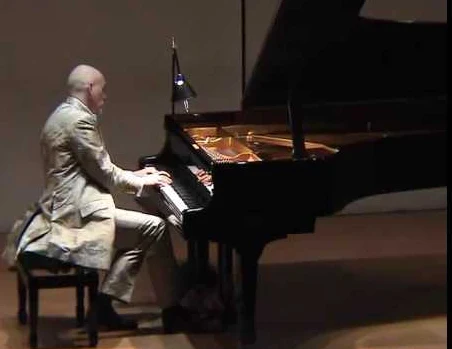
My brother Luigi Gordon plays piano and keyboards on La gnove lune. Here you can hear him in two sonatas by Domenico Scarlatti.
The luissgordon YouTube channel ↗
Scarlatti, Sonata in C minor, K. 115 ↗
Scarlatti, Sonata in E major, K. 531 ↗
Luigi Gordon Lovisoni on Myspace ↗